
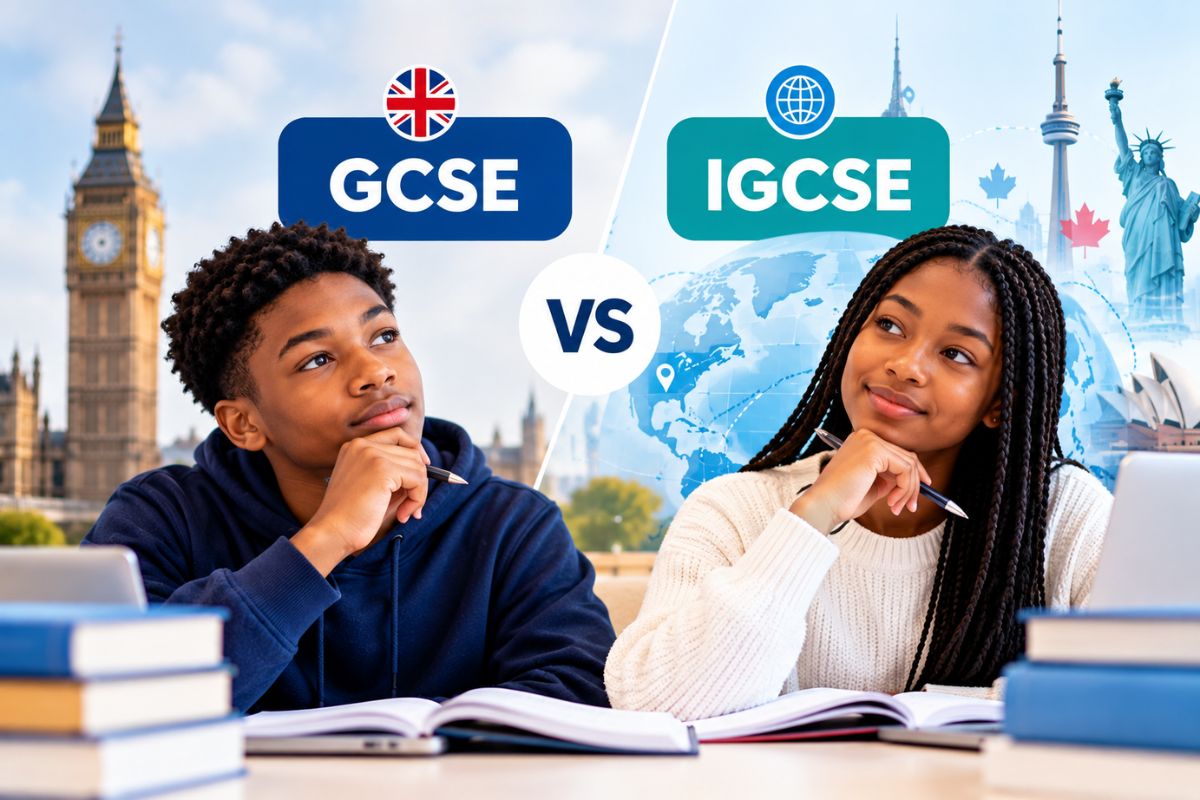
If your child attends an international school or is preparing for secondary school examinations, you may have come across two familiar names: GCSE and IGCSE.
Both qualifications are widely recognised and can prepare students for further study. However, parents often wonder what actually separates them.
Is one harder than the other?
Does IGCSE have an advantage?
Which one is better for university applications?
The answer is more nuanced than simply choosing one over the other.
What Is a GCSE?
GCSE stands for General Certificate of Secondary Education.
It is a major qualification taken by students in the UK, typically during secondary education. Students can study a range of subjects, including Mathematics, Biology, Chemistry and Physics.
GCSE courses are assessed according to the requirements of the relevant examination board and subject specification.
The qualification provides students with an academic foundation for the next stage of education, including A Levels and other post-16 pathways.
What Is an IGCSE?
IGCSE stands for International General Certificate of Secondary Education.
It was developed with an international audience in mind and is widely offered by schools outside the UK, including international schools.
Like GCSEs, IGCSEs cover a wide range of academic subjects and can provide preparation for further study.
The exact content, assessment structure and examination requirements depend on the particular subject and examination board.
GCSE vs IGCSE: What Is the Main Difference?
The biggest distinction is the educational context in which the qualifications were designed and offered. GCSEs are primarily associated with the UK education system, while IGCSEs were designed with international schools and students in different countries in mind.
However, the difference is not simply:
GCSE = UK
IGCSE= International
Students can encounter different examination boards and specifications, and schools may make their own curriculum choices. That is why parents should always look at the specific subject specification rather than relying only on the name of the qualification.
Are GCSEs and IGCSEs Equally Recognised?
Both qualifications are widely used as secondary-school qualifications and can support progression to further education. However, universities and schools may have their own entry requirements for particular programmes. If your child is planning to study at a particular university or move between education systems, it is sensible to check the relevant institution's published requirements.
The important point is that parents should look beyond the label and consider the student's specific subjects, examination board, grades and intended next step.
Is IGCSE Harder Than GCSE?
This is one of the most common questions parents ask.
There is no simple answer.
Difficulty depends on the subject, specification, examination board and individual student. A student may find one specification more demanding than another because of the topics covered, the style of assessment or the way questions are presented. Rather than asking which qualification is universally harder, a more useful question is:
Which specification is my child studying, and what does it require them to know and apply?
Why the Examination Board Matters
A subject such as Mathematics can look very different depending on the specification being followed. The topics may overlap substantially, but the way students are expected to apply their knowledge can vary. This is particularly important when preparing for examinations. A student should practise questions that reflect the actual specification and assessment style they will face. This is one reason generic revision materials are not always enough.
What Should Parents Consider?
If your child is studying GCSE or IGCSE, consider these five areas:
1. The Examination Board
Find out which examination board your child's school uses.
2. The Subject Specification
Understand the topics and skills students are expected to develop.
3. Assessment Structure
Know whether the subject involves examinations, coursework or other forms of assessment.
4. Your Child's Current Level
Identify areas where your child is confident and where additional support may be needed.
5. Future Academic Plans
Consider what your child plans to study next and whether there are specific requirements to keep in mind.
What About Parents With Children in International Schools?
International schools may follow different combinations of UK, US, Canadian or other curricula.
For parents, this can sometimes make academic planning more complicated.
A student may be studying an international curriculum while preparing for an examination that has its own specific structure and expectations.
Understanding the curriculum early allows parents to identify appropriate resources and academic support before examination pressure increases.
How Tutoring Can Help
Good tutoring should begin with the student's actual curriculum and current level.
Rather than simply giving a student more questions, the tutor can identify learning gaps, explain difficult concepts, practise relevant question types and gradually introduce more challenging problems.
For GCSE and IGCSE students, this can include:
- Concept revision
- Problem-solving practice
- Examination-style questions
- Identifying learning gaps
- Revision planning
- Application of knowledge
- Exam preparation
The aim is to help students understand what they are learning and become increasingly confident in applying that knowledge.
The Most Important Question Is Not GCSE or IGCSE
For most parents, the better question is not:
"Which one is better?"
It is:
"What qualification is my child studying, what does their specification require, and how can we support them effectively?"
Once those questions are clear, it becomes much easier to identify the right resources, revision strategy and academic support.
Need Help With GCSE or IGCSE?
At Onayemi Academy, students receive personalised support in Mathematics, Further Mathematics, Physics, Chemistry and Biology, with lessons structured around their curriculum, ability and academic goals.
Book a Free Trial Lesson →